
 Official Site
Reimagine Travel vs. Tomas Travel Portal
Why Forward-Thinking DMOs, Tourism Boards & Destination Operators Are Moving On
The System That Built Yesterday’s Tourism Infrastructure Can’t Sell Todays Experiences
Tomas Travel Portal (tportal.tomas.travel) has been part of the regional tourism landscape in Germany and Austria for years. For its time, it served a real purpose: aggregate local operators, standardize listings, and give destinations a centralized booking presence.
That time has passed.
The world your customers live in now — one-tap mobile bookings, instant confirmation, Stripe-native checkout, urgency-driven conversion flows — was not designed around Tomas. And Tomas was not designed around it.
The question for any DMO, tourism board, or destination entrepreneur in 2024 is not whether Tomas works. It’s whether “works” is enough when your competitors are converting bookings you’re losing.
What You’re Actually Getting With a Tomas-Style DMO System
Centralized Control — But Not Yours
Tomas is built around a DMO-first structure. The destination controls the inventory. The destination controls the listings. The destination controls the UI. Individual operators are integrated into the destination’s database — they don’t own a platform, they’re a row in someone else’s system.
If you’re the DMO, you control the data but inherit all the constraints of legacy infrastructure. If you’re an operator, you’re renting visibility on someone else’s platform — with limited branding, no direct customer relationship, and no ability to optimize your own conversion flow.
Reimagine gives every operator their own standalone dashboard. They manage their own tours, schedules, pricing, and passenger lists — independently, without touching the platform owner’s backend. They own their presence. You own the platform they run on.
Legacy Architecture — Built for an Earlier Web
Tomas is a centralized server-side booking system. It was engineered for the XML/API feed era — structured data pipelines, fixed booking logic, centralized database control. That architecture made sense when it was designed.
Modern travel booking runs on:
- Modular microservices
- Real-time inventory APIs
- Lightweight JavaScript checkout flows
- Mobile-first viewport logic
- Stripe-native payment stacks
Tomas was not built for any of these. Adapting it to modern conversion standards requires working against the system’s own architecture — not with it.
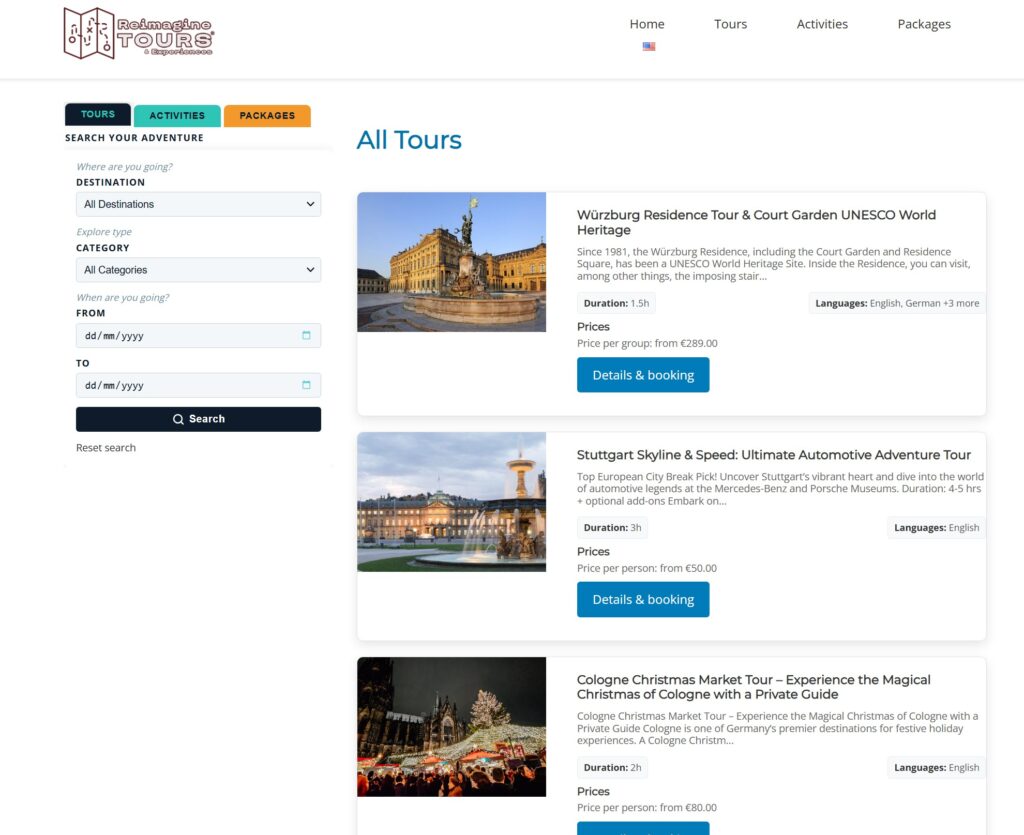
Reimagine was built natively for the modern web. AJAX-powered search. Modal checkout with no page redirects. Live inventory counters. A+ Core Web Vitals. Mobile-first from the ground up — not retrofitted.
Template UI — Functional, Not Competitive
Tomas frontends are template-based. There is limited customization and a rigid UI structure. The booking flow is functional but not optimized for conversion in the way a purpose-built direct booking engine is.
In practice, this means:
- No sticky booking widgets that follow users as they scroll
- No modal-based checkout (visitors get redirected away from the tour page to complete a booking — the single biggest driver of cart abandonment)
- No live urgency counters (“Only 3 seats left”)
- No smart social proof badging
- No contextual cross-selling or upsell logic at checkout
- No automated cart abandonment recovery
These are not optional features. They are the difference between a system that displays tours and a system that sells them.
Payment Infrastructure From a Different Era
Payment processing in Tomas deployments typically means one of two things: redirection to an external payment gateway, or an embedded third-party processor integrated at the DMO level.
Neither is a modern checkout experience. Neither is optimized for the moment a traveler decides to book and needs zero friction to complete the purchase.
Reimagine runs native dynamic payment flows — deposits, split payments, pay-later — built directly into the checkout engine. No redirect. No third-party page. The booking completes inside the platform. Stripe and PayPal Connect handle automated commission splits between the platform owner and individual operators instantly on every transaction.
Cost: €100–€500+ Per Year. For Someone Else’s Platform.
Tomas-style DMO portal systems are not priced like modern SaaS tools. The cost structure is institutional:
- Annual DMO/platform licensing contracts
- Integration and maintenance fees
- Per-operator or per-destination service agreements
- Additional fees for API access, channel management, or booking modules
Mid-sized destination implementations typically run €100 to €500+ per year. Large city or regional deployments exceed this significantly when maintenance contracts, data integration, and support agreements are included.
And at the end of each year, you have paid to be inside someone else’s system. You do not own the platform. You do not own the booking engine. You do not own the conversion infrastructure. You are a customer of legacy tourism infrastructure — paying annually to stay dependent on it.
Reimagine is a one-time purchase. You own the platform. You own the booking engine. You own the operator relationships, the customer data, and the revenue architecture. The infrastructure is yours — permanently.
Innovation at Institutional Speed
Tomas evolves on the timeline of institutional procurement. New features require governance decisions, contract amendments, and slow release cycles. You cannot integrate a new CRM tool, swap a payment processor, or add a modern analytics stack without navigating the system’s own integration complexity.
Reimagine is built on WordPress — the most flexible, developer-supported CMS on the planet. Connect any CRM. Add any analytics layer. Integrate any tool your team already uses. Push updates when you need them, not when a procurement cycle allows.
The Core Difference: Infrastructure vs. Platform Ownership
| Reimagine Travel | Tomas Travel Portal | |
|---|---|---|
| Ownership model | You own the platform | You license access to theirs |
| Annual cost | One-time purchase | €100–€500+/year |
| Operator independence | Full standalone dashboards | Integrated into central DMO database |
| Checkout flow | Modal, no redirect, frictionless | Redirect-based, older-style flow |
| Mobile optimization | Mobile-first, native | Template-based, limited |
| Urgency & conversion tools | Live counters, sticky widget, badging | Absent |
| Payment stack | Stripe/PayPal Connect, native splits | Regional PSPs, external gateways |
| Cart abandonment recovery | Automated | Not available |
| SaaS monetization model | Built in (subscriptions + modules) | Not available |
| B2B / Agency portal | Built in | Not available |
| Innovation cycle | On your schedule | Institutional procurement pace |
| CRM / Analytics integration | Open, connect anything | Complex, limited |
| Branding control | Full | Destination-controlled, limited per operator |
| Architecture | Modern, modular, lightweight | Legacy centralized server-side |
The Strategic Question
Tomas Travel Portal is public tourism infrastructure. It was designed to standardize and aggregate — not to compete for direct bookings, not to optimize conversion, and not to give operators or platform owners a commercial advantage.
If your goal is to participate in a regional destination database, Tomas serves that purpose.
If your goal is to own a booking platform — one that earns commission on every sale, converts visitors at modern rates, gives operators real independence, and generates SaaS revenue from the infrastructure itself — Tomas is not that system. It was never designed to be.
Reimagine was.
What Reimagine Gives You That Tomas Cannot
Own the platform, not just the listing. Every booking, every customer relationship, every commission — yours. Not filtered through a DMO governance structure you don’t control.
Run two revenue models simultaneously. Operators pay to list on your marketplace (you earn commission on every booking), or pay a SaaS subscription to run their own branded booking presence on your infrastructure. Both models, one platform.
Conversion infrastructure that actually closes bookings. Sticky booking widgets. Modal checkout. Live urgency counters. Smart badging. Cart abandonment recovery. Cross-selling at checkout. Every tool that turns a browsing traveler into a paid booking — built into the core engine.
Modern payments, instantly. Stripe and PayPal Connect with automated splits. Deposits, pay-later, split payments — native to checkout. Not redirected. Not bolted on.
Performance that scales. A+ Core Web Vitals. No legacy database overhead. Fast at 10 operators. Fast at 100.
For DMOs and Tourism Boards Specifically
Reimagine was built with DMO and city tourism board architecture in mind.
- Multi-vendor structure supports as many operators as your destination has
- Each operator manages their own tours, schedules, and availability independently
- You control the platform, the branding, and the revenue model
- Operators can be on a commission model, a SaaS subscription model, or both
- B2B portal gives hotels, concierges, and corporate buyers exclusive wholesale access
- Full translation and multi-currency support for international visitors
The result is a destination booking platform that looks, performs, and converts like a modern commercial product — not like institutional tourism infrastructure from a previous decade.
Reimagine Travel Booking & Tour Engine Advanced Tour Operator & Package SaaS Booking Platform & Theme