
 Official Site
TOUR ENGINE | RT AI GEO ENGINE
What Is Generative Engine Optimization (GEO), and How Does Our AI System Help Your Site and Products on Search Engines, AI Overviews and AI Platforms and Increase Your Bookings? SEO and AI Analysis – Tour Engine
We have an AI team working every week, studying our system, other systems and AI, and how search engines and searches have changed. We focus on ChatGPT, Gemini, Google AI Overviews, Grok, Siri, Claude AI, Google AI Mode and Perplexity, and we analyze their AI responses. What they learn goes straight into the Tour Engine’s RT AI GEO Engine, the set of built-in features described in this article.
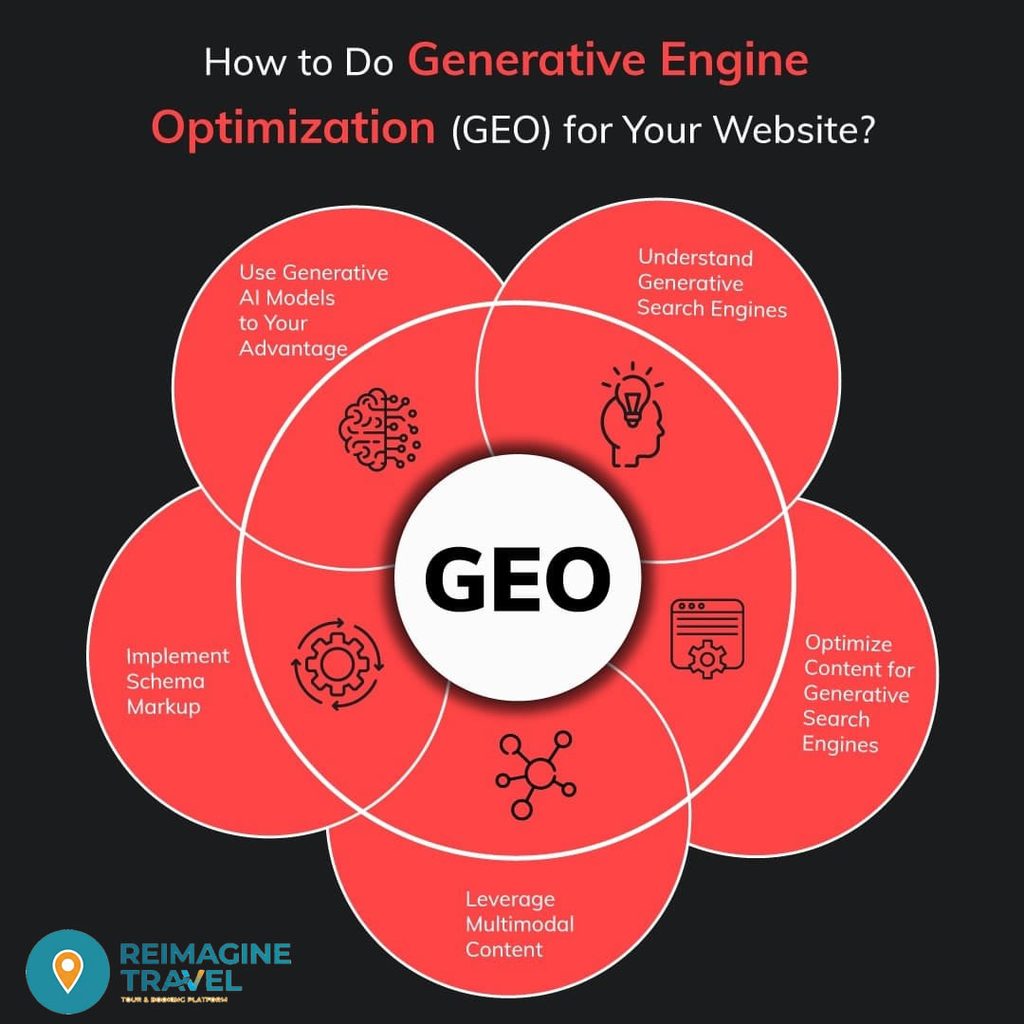
What Is Generative Engine Optimization (GEO)?
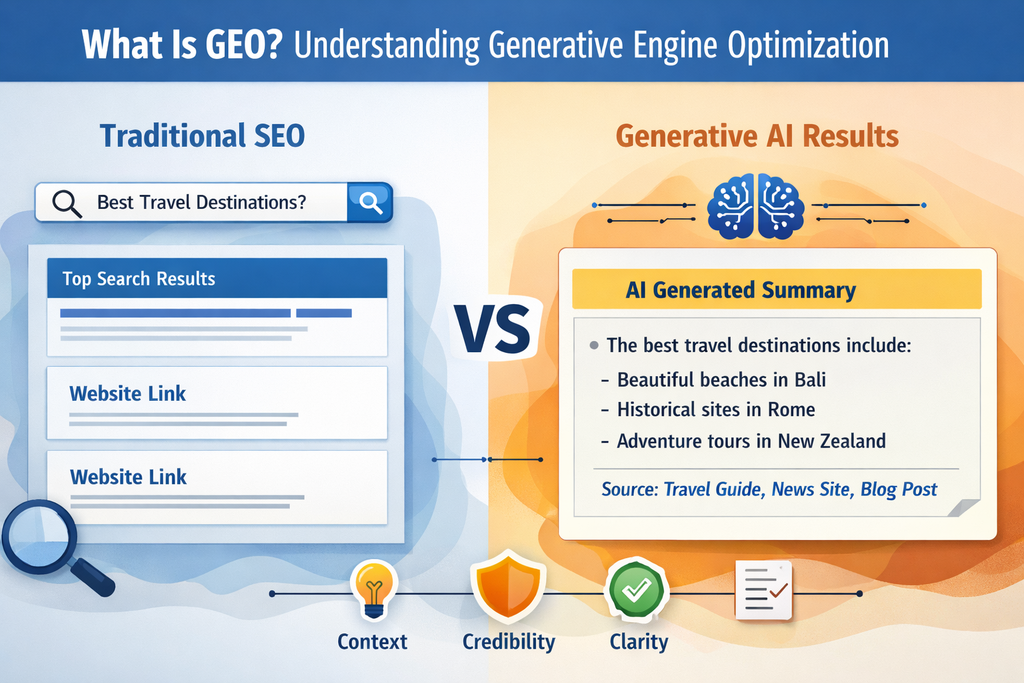
Generative Engine Optimization (GEO), also called AI search optimization or Answer Engine Optimization (AEO), is a modern branch of digital marketing. Its goal is to make a company’s website and online presence clear, credible and easy for Google and AI systems to reference when answering customer searches. It focuses on getting a website to appear inside AI answers and Google AI Overviews, not just in standard blue-link results.
Google’s own documentation confirms that traditional SEO fundamentals remain important for appearing in AI Overviews. Google recommends crawlable content, clear internal linking, accurate structured data and helpful content. It does not require a special AI file or special schema, and there is no guaranteed trick that gets a business featured. To appear in an AI Overview for a local niche such as “Santa Clara County wine tour,” a tour company combines traditional SEO foundations with AI-specific optimizations. That combination is what the RT AI GEO Engine builds into your website.

The traditional way to be found was SEO, and the way people search has changed. Google search visits per site are falling rapidly, with clicks dropping 30–52% per year, and OTAs are struggling as their organic search traffic falls. The demand is still there. Travelers now ask AI systems to research destinations, compare experiences and recommend what to book, so your website and booking engine need to be clear and credible to those systems.
Part 1: The Foundation Built Into Tour Engine
Advanced SEO with Automatic Schema Markup
The Tour Engine theme and booking engine include advanced SEO with schema markup applied automatically across all relevant content types. Structured data is generated and embedded without any manual configuration, so search engines can accurately interpret and index tours, destinations, pricing, availability and other key entities. Every published page gets a technical SEO foundation that meets current best practices out of the box, which reduces setup time and removes the risk of missing or malformed markup.
The schema markup includes:
- TouristTrip, Organization, Person, FAQPage, Event, Product and AggregateRating
- Entity graph connections linking Organization, Person, Tour and Provider entities
Schema generation is centralized in one system, which keeps the markup consistent across the site.
Automatic Support for AI Search Engines and AI LLMs
GEO is the next frontier of search visibility, used heavily by Google and designed for AI-driven search engines that synthesize answers rather than simply return links. Tour Engine includes full automatic GEO support, integrated with all major AI chat engines:
- A Schema Entity Graph that defines and connects the key entities of your business.
- A dynamically generated robots.txt that controls AI crawler access and allows AI bots to crawl the site.
- An E-E-A-T content template (Experience, Expertise, Authoritativeness, Trustworthiness) that reinforces credibility signals.
- Direct Answer formatting that enables AI engines to surface your content as authoritative responses.
Technical SEO Foundation
- Open AI-crawler policy in robots.txt.
- Complete sitemap covering tours, activities, locations and other content types.
- Server-rendered HTML, so pages do not depend on JavaScript for crawling. Price, availability and policies appear in server-rendered HTML and are readable without JavaScript.
- Clean URL structures.
- Fast page loading (A+ Core Web Vitals level) and a mobile-friendly design.
- No restrictive snippet directives: no nosnippet and no Googlebot blocking.
- Full indexing.
Built-In GEO Tools
FAQ system. A dedicated structured question-and-answer field (_faqs) for tour content, displayed on tour pages. The structure is automated and you author the question and answer text.
GEO Direct Answers. A dedicated geo_direct_answer field supports concise, self-contained answers for generative search. It is registered across ten content types: tours, extras, activities, packages, rentals, posts, pages, tickets, listings and events, and answers can be generated automatically from existing content.
Dedicated GEO components. JSON-LD schema generation, llms.txt generation, and an admin interface for managing direct answers and Power Phrases.
Automatic `llms.txt`. A machine-readable directory of your content organized by post type, with titles, URLs and full descriptions, grouped by category.
Structured inclusions and exclusions. Separate _inclusions and _exclusions fields, managed and displayed consistently.
A Site Architecture Built for Discovery
- Dedicated templates for tours, events, packages, rentals, tickets and listings.
- Dedicated archive templates for tours, activities, events, extras, packages, rentals, tickets and listings.
- A hierarchical location taxonomy that connects offerings to destinations and geographic areas.
- Dedicated category taxonomies for tours, activities, extras, packages and rentals.
- Official-site SEO features, including an Official Site badge and meta description functionality.
- Multi-operator and partner support through the partner/site-owner role system and a Provider post type for partner businesses.
Tour Engine did not begin as a conventional booking theme that had to be retrofitted for AI search. GEO and SEO are part of its architecture.
Part 2: RT AI GEO Engine Features and How They Work
The RT AI GEO Engine builds on that foundation. It helps AI systems understand what your business offers, where it operates, who its services are for and which information supports a recommendation. It works as a connected system: your business is discoverable, your products are understandable, your information is verifiable and your booking process is clear.
AI LLM Info Hub
The AI LLM Info Hub is a dedicated HTML page at /ai-llm-info-hub/: the central hub for AI systems to understand your business. It opens with the line “The complete AI LLM Knowledgebase full of Q&A on our content, references and content index” and serves as the home start page for AI systems. It is a real page, not only an llms.txt file.
The hub brings together:
- Business summary with founders and ownership, and parent-company information where applicable.
- A complete URL index of all important pages, each with a substantial description of what it contains and how it relates to your services.
- Partner business network with descriptions.
- Service categories with detailed descriptions.
- Geographic regions covered.
- Contact details and official social media links.
- External platform connections, including booking platforms and business profiles.
- Press and fact-sheet component: a public section that tourism boards, bloggers and journalists can cite, with founders, named tours, partners, regions and consistent names.
- Reviews component: imports qualifying reviews with source, author, date and rating, limited to 10 to 20 reviews on the page. You choose which reviews qualify.
- Q&A generation: questions and answers generated from tour fields, review patterns and destination knowledge, not only from tour fields.
The hub is regenerated automatically whenever products, pages or reviews change, so it always matches the live website.
Automatic Destination Landing Pages
Destination landing pages are generated automatically from your location taxonomy. When you create or update a location such as “Würzburg,” Tour Engine builds a landing page for it without manual setup, pulling data from the tours assigned to that location. The target query phrase, for example “Würzburg food tour in English,” appears in the title, H1 and URL, all taken from the location data.
- H1: generated from the location name, for example “Würzburg Food Tours & Experiences.”
- Direct Answer block (first 100 words): generated from tour data, covering the cities served, starting prices and tour count.
- Structured Q&A subheadings, each generated from a tour field: which food is included (_inclusions), where tours pick up guests (meeting point), the price, private or group (group type), how long the tour lasts (duration), best season (seasonality), accessibility, group size limits and languages available.
- Auto-update: the page regenerates when tours are added or changed in that location.
- Sub-area pages generated from the location hierarchy, such as Franconian food tours, Romantic Road tours and Bavarian castle tours.
- Named attraction and winery pages generated from provider data for specific landmarks and partners.
- CollectionPage schema on every page.
A differentiator meta field on every tour captures your named experiences, signature routes and facts, and what only you offer. This keeps generated pages and Q&A from becoming boilerplate.
Destination, Service and Occasion Pages
Service-combination pages cover specific offers such as private tours in Munich, guided tours in Vienna and private shore excursions in European cruise ports, each with a comprehensive description and internal links to the relevant tours. Separate pages for different experience types, seasonal events, private groups and special occasions let each visitor land on the page that fits their need.
Category and Location Directory Pages
Directory pages organize your offerings in two ways. Category directories cover tour types such as food tours, castle tours, city tours and Christmas market tours, at URLs like /food-tours/ and /castle-tours/. Location directories cover Würzburg, Munich, Vienna, the Romantic Road and other destinations, at URLs like /wurzburg-tours/ and /munich-tours/. Titles and H1s target queries such as “Castle Tours in Bavaria” and “Private Tours in Würzburg.”
Each directory page includes a description with geographic context, a complete list of the tours and activities in that category or location, a brief description of each with key details such as duration, price and highlights, an internal linking structure, geographic entity associations, and CollectionPage or ItemList schema. Tours, destinations, categories and partners are connected, not isolated pages.
Structured Q&A Sections on Every Tour
Every tour carries question-style headings with direct, self-contained answers that Google and AI systems can lift as passages. Headings cover price, duration, pickup locations, what is included, best season, accessibility, group size and languages, and match real search queries, such as “What is the best Würzburg food tour?”, with the factual answer immediately beneath. The _faqs structure feeds FAQPage schema automatically.
For authors, admin guidance explains how to structure Q&A, and the Power Phrases helper includes Q&A templates. The differentiator field keeps the answers specific to your tours.
Detailed Product Information for Follow-Up Questions
After an AI recommends a tour, travelers ask follow-up questions: which option is best for a birthday group, what the price includes, whether it is private, whether it works for a five-year-old, whether Saturday is available, whether it suits a romantic date. Structured fields on every tour answer them:
- Target audience and occasions (birthday, anniversary, romantic, family, corporate)
- Age restrictions and child suitability
- Private versus group experience
- Group size limits
- Weather policies and contingencies
- Availability by day and time
- Differences between similar options
These fields display on the tour page and feed the TouristTrip schema.
Structured Content Sections on Every Tour
Tour pages present information in clear, extractable sections, populated from meta fields wherever possible:
- Itinerary with timestamps, built from reusable itinerary items.
- Things to know, combining a “Things to know” meta field with automatic data such as wheelchair accessibility, cancellation terms and age restrictions.
- What to bring.
- Why book with us, from a “Why book with us” meta field.
- Included and Excluded lists.
- Practical details pulled automatically: meeting point, languages, duration, maximum people, minimum per group, wheelchair accessibility, cancellation weeks and refund percent.
Direct Answers on All Content Types
The geo_direct_answer display is available on all ten content types: tours, events, extras, activities, packages, rentals, tickets, listings, posts and pages. Each detail page includes an “About This Tour,” “About This Package,” “About This Rental” or matching section that gives a concise explanation of the product, so every product type presents information in the same consistent way. The “Things to know” and “Why book with us” meta fields are included in all content types.
Geographic Entity Association
Geographic meta fields on tours capture regions, nearby cities, landmarks and AVA or appellation names, and this context is shown explicitly in the content, for example “South Santa Clara County” or “the Franconian food region.” Pages name the specific cities, appellation regions and wineries a tour visits, which ties your business to the exact local niche people search for. Place and LocalBusiness schema carry accurate geographic details, including latitude and longitude, and TouristTrip schema connects each tour to its actual locations.
People, Partners and Local Entities
- Founders and ownership information displayed prominently, with parent-company identification where applicable.
- Author schema with detailed person information, and guide profiles that display credentials.
- A partner business network display built on the Provider post type, linking your company with wineries, local destinations and the surrounding tourism economy.
- Partner business schema connections, with partner pages describing each business and its role in the experience.
External Authoritative Links
Tour pages include a “Learn More” or “Official Resources” section linking to official tourism boards, attraction websites, UNESCO World Heritage pages, Wikipedia articles about locations and attractions, local visitor bureaus, regional travel guides, government tourism websites and reputable travel publications. The same sources are connected in your schema through sameAs, which helps AI systems validate your content.
Complete, Conditional and Linked Schema
- Complete core schema: FAQPage, Organization, TravelAgency, BreadcrumbList, WebPage and WebSite, kept complete and accurate and checked with schema validators.
- Additional types: LocalBusiness, TouristAttraction, Place, Service and Offer (price, availability, priceSpecification), always matching visible content.
- Conditional Winery schema, added only when both the tour category and its tags or meta fields indicate winery content.
- Semantic JSON-LD entity linking: stable @id references such as /#organization and /tour/123#schema, plus sameAs links to Wikipedia, Wikidata and official tourism sites, connecting Organization, Person, Tour, Location and Provider across all pages.
New schema follows the existing schema pattern, so working markup is never broken.
Brand and Product Name Consistency
Brand and product names stay consistent across page content, schema (Organization, TouristTrip, Product), the AI LLM Info Hub and Provider data. Brand information comes from the site owner role and Provider data and flows into the schemas automatically, so nothing needs to be entered twice.
Enhanced llms.txt
The automatically generated llms.txt includes full descriptions instead of short excerpts and is organized by category. It complements the AI LLM Info Hub, and both stay consistent with your website content.
Automatic Google Product Feed
Tour Engine can automatically generate a feed for Google products, so your tours and experiences can be submitted to Google without building or maintaining a feed by hand. The feed is created from the same product information already on your site, such as titles, descriptions, prices, images and links. This gives Google structured, consistent product data that supports visibility in Google’s shopping and product surfaces. Setup and links to the Tour Engine product feeds are made in the theme settings and in Google.
Social and Booking Platform Connections
Social profiles (Instagram, Facebook, LinkedIn, TikTok) and booking platforms (TripAdvisor, Viator, GetYourGuide, Expedia, Booking.com) are connected prominently on the website and in the AI LLM Info Hub, and are represented consistently in both.
Knowable and Bookable: The Website’s Three Jobs
- Give AI a reliable source of current business facts: products, prices, schedules, meeting points, policies, limitations and differences, published where they are easy to extract.
- Let customers verify the recommendation: when a traveler clicks through from an AI answer, the page confirms what the AI said and gives enough context to trust it.
- Make booking easy and safe: current availability, clear price and inclusions, what happens next, and a clear direct-booking path.
Content for Different Query Intents
The engine supports content for each kind of question travelers ask. Broad information questions such as “What is the Franconian food region?” are answered with destination knowledge on blog posts, covering food regions, culture, geography and history. Comparison questions such as “Best food tours in Würzburg” are answered with why-choose-us and positioning content. Specific-need questions such as “Private food tour for a birthday near Munich” are answered with specific experience pages and occasion-based content for birthdays, anniversaries, romantic outings, families and corporate events.
Building Your Presence Beyond the Website
Google Business Profile. Maintained as its own asset, separate from website SEO: complete categories, location, hours, phone number, reviews and photos, kept consistent with your Google Maps listing. Branding and profile links are set in the theme settings.
Independent mentions and co-citations. AI systems cross-check claims across independent sources, so your presence on TripAdvisor, Yelp, Reddit, regional news articles, travel blogs, “best tours” roundups, tourism-board and regional directories, and industry and chamber of commerce listings strengthens your credibility. Your consistent business information, genuine reviews and these independent references work together.
Monitoring AI Visibility
Visibility is monitored across ChatGPT, Gemini, Google AI Overviews, Google AI Mode and Perplexity using a fixed set of representative questions: broad destination questions, activity questions and detailed questions based on what you actually sell. Tracking records how often your business appears, which pages are cited, and whether citations come from your site or from third-party sources, and compares the results before and after website changes. Google Search Console confirms that important pages are crawled and indexed and tracks search visibility, website analytics track identifiable AI referral traffic, and Ahrefs adds ranking and backlink context. Google rankings and AI citations are measured separately.
Part 3: What Is Automated and What Needs Human Authoring

The RT AI GEO Engine automates the structure, layout, data and schema. Your own words, your story and your expertise are authored by you in the places shown below. This distinction matters, because automated structure only works well when the human-authored content in it is specific to your business.
What Is Automated
These come from existing meta fields and settings:
- Meeting point display
- Inclusions and exclusions lists
- Languages
- Duration
- Group size limits
- Accessibility status
- Cancellation and refund policy terms
- Price display
- Private versus group status
- Availability by day and time (if in the system)
- Age restrictions (if in the system)
- Geographic coordinates
- Schema markup, which reflects visible content
- Direct answer field structure
- Q&A section structure and format
- Destination page layout template
- Brand name consistency, from the site owner role and Provider data
- Reviews import with source, author, date and rating (you decide which reviews are selected)
- The meta field structures for “Things to know,” “Why book with us,” the differentiator, the press/fact-sheet and competitive positioning (the last two in the site owner user role)
What Needs Human Authoring
These need your input, written in the place shown:
| Content | Where you author it |
| Narrative “Things to know” paragraphs: practical explanations beyond meta field data | “Things to know” meta field (included in all content types) |
| “Why book with us” value propositions: persuasive messaging and positioning | “Why book with us” meta field (included in all content types) |
| Detailed itinerary descriptions with timestamps, and the narrative of what happens on the tour | Reusable itinerary items (the itineraries already exist; add timestamps) |
| Q&A and FAQ text: the actual questions and answers | _faqs meta field (the structure is automated) |
| Unique differentiators: named experiences and signature routes or facts only you offer | Differentiator meta field in the content type meta |
| Press and fact-sheet narrative: brand story, founder bios, unique value propositions for journalists | Site owner user role meta fields |
| Competitive positioning: why choose us, comparison with alternatives | Site owner user role meta fields |
| Destination knowledge: food regions, cultural context, geographic and historical information | Blog posts |
| Occasion-based content: birthday, anniversary, romantic, family and corporate suitability | Blog posts |
| “What to bring” recommendations based on weather, season and tour type | FAQs (see the recommended FAQs per content type) |
| Weather policy narratives: detailed contingency plans | Terms and conditions documentation |
| Google Business Profile and branding; Google search engine and Google Products setup; links to the Tour Engine product feeds; Google business activities, services, products, reviews, photos, posts and advertising | External setup in Google, plus the theme settings |
The Guiding Principle of the RT AI GEO Engine
Every feature is judged by two questions.
Does this help the right customers and systems find the business? This is the Known objective: making your business discoverable through relevant content, geographic context, technical accessibility, independent mentions and clear relationships between business entities.
Does this help them understand, trust and book it? This is the Knowable and Bookable objective: complete product information, accurate practical details, a credible business identity, consistent references, current availability and a clear booking path.
The RT AI GEO Engine is not about chasing a single ranking factor or producing content for its own sake. It connects technical infrastructure, useful content, business identity, geographic relevance and independent recognition into one system, so your business is easier to discover, easier to understand and easier to book as travelers increasingly rely on AI-powered search and recommendations.